David and Goliath
Two armies faced off across a valley, the Philistines on one hill, Israel on the other, with nothing but open ground between them: the Valley of Elah.
Then out from the Philistine camp walked something Israel had never seen up close: Goliath, from Gath. Scripture describes him as enormous, covered head to toe in bronze armor, a spear in his hand, and a man walking ahead of him just to carry his shield.
Goliath stepped out into the open valley and shouted, loud enough for the whole army of Israel to hear.
“Choose a man,” he challenged. “Let him come down and fight me. If that man defeats me, the Philistines will serve Israel. If I defeat him, Israel will serve the Philistines.”
Saul and all his men heard it. And Scripture doesn't soften what happened next: they were dismayed. Greatly afraid.
And this was not a one-time thing. Morning and evening, morning and evening, Goliath came out and said it again. For forty days.
Meanwhile, far from the battle, in Bethlehem, lived a man named Jesse, who had eight sons. His three oldest were already off with Saul's army.
David was the youngest, going back and forth from Saul to Bethlehem so he could care for his father's sheep.
One day Jesse called David over. Take this grain and bread to your brothers, he said, and these cheeses for their commander, and come back and tell me how they are doing.
So early the next morning, David set out.
David left the sheep with someone to watch them, just as his father had told him, and carried the food toward the camp.
He arrived just as the army was moving out to its battle line, soldiers shouting as they took their positions, Israel on one side, the Philistines on the other.
David dropped the supplies with the man guarding the baggage, then ran, actually ran, toward the battle line to find his brothers.
And right in the middle of saying hello, Goliath came out again.
David had only come to deliver food. Now here he was, standing near a real battle line, hearing Goliath's challenge with his own ears.
The soldiers around him had heard it dozens of times already. For David, it was brand new.
Imagine your morning starting with a simple errand for your family, and ending with you standing in front of an army and a giant. How do you think that would feel?
What would you want to ask David right now? Hold onto that question. Let's see what happens next.
David heard Goliath's challenge, and then watched what every soldier around him did: they ran. Scripture says they were very afraid.
The soldiers started talking about the reward Saul had promised: riches, marriage to the king's own daughter, and his whole family excused from paying taxes.
David started asking around about that reward. Then he asked a very different kind of question.
David said: “Who is this uncircumcised Philistine, that he should defy the armies of the living God?”
The men told David again what the reward would be. But David's oldest brother Eliab overheard him asking about it, and he was not happy. Why had David even come down here? What about the sheep?
David answered him, then simply turned and kept asking the same questions to whoever would listen.
Word of what David was saying reached Saul. And Saul sent for him.
David came before King Saul and said: “Let no man's heart fail because of him. Your servant will go and fight with this Philistine.”
Saul answered him: “You are not able to go against this Philistine to fight with him.” He pointed out that David was a youth, while Goliath had been a warrior from his own youth.
David did not argue about his age at all. Instead, he told Saul a story, something that had actually happened while he was out with the sheep.
When a lion or a bear came and snatched a lamb from the flock, David said, he went after it. He struck it. He got the lamb back out of its mouth. And if the animal turned on him, he fought it too.
“Your servant has struck down both lions and bears,” David told Saul.
Then he turned to Goliath. This Philistine, David said, had defied the armies of the living God. And he was not finished yet.
“The Lord who delivered me from the paw of the lion and from the paw of the bear will deliver me from the hand of this Philistine,” David said.
Saul listened, then answered: “Go, and the Lord be with you.”
David had not taken one step toward Goliath yet. He had not even picked up a single stone.
But before any of that, he had already said out loud who he believed would save him.
Think about that for a second. Saul had pointed straight at David's age, told him he was too young.
David answered instead by talking about what had happened while he cared for the sheep, and then said: “The Lord ... will deliver me.”
What does David actually talk about here? His own size? His own strength? Or something else?
What would you want to ask David before he went any farther?
Saul tried to help the only way he knew how: he dressed David in his own armor, a bronze helmet, a heavy coat of armor, his own sword strapped on top.
David tried walking in it. He barely made it a few steps before he stopped.
“I cannot go in these, because I am not used to them,” David said, and took the armor off.
He did not say it was too heavy. He did not say he was too small. He simply gave his own reason: he was not used to it.
So David took his staff instead, walked down to the brook, and chose five smooth stones, dropping them one by one into his shepherd's bag.
Sling in hand, David walked out to meet Goliath, who was walking toward him too, his shield-bearer still out front.
When Goliath looked at David, Scripture says he despised him, and then he began to speak.
“Am I a dog, that you come to me with sticks?” Goliath said, cursing David by his gods and threatening him.
David answered: “You come to me with a sword and with a spear and with a javelin, but I come to you in the name of the Lord of hosts, the God of the armies of Israel, whom you have defied.”
And David was not finished speaking.
David said that everyone would know there was a God in Israel, and that everyone gathered there would know something else too: “The Lord saves not with sword and spear.”
“For the battle is the Lord's,” David said.
Notice when he said this: before the fight was even over. Before the stone was thrown. Before Goliath had even fallen.
David had already said who the battle belonged to.
Goliath is still standing. Nothing has happened yet. David still has his sling, and the stones are still sitting in his bag.
But David has already said: “The battle is the Lord's.”
What part of what David said sticks with you most? What is he really saying about the sword and the spear?
Why do you think those words matter, even before we see what happens next? Take a moment together, then turn the page.
Then Goliath started moving toward David. And David did not wait, he ran, straight toward him.
One hand into the bag. One stone. Into the sling.
David swung the sling and let the stone fly. It struck Goliath in the forehead, and the giant fell, face down, onto the ground.
First Samuel says David prevailed over Goliath with a sling and a stone, and David had no sword in his hand.
But the story did not stop there. David ran to Goliath, took his sword, and with that sword finished the fight.
It happened in that order: the stone brought Goliath down first, and only then did David use the giant's own sword to finish it.
The moment the Philistines saw their champion was dead, they turned and ran.
Then the men of Israel and Judah rose up and chased after them. The very same army that had been too afraid to move was now running forward.
Later, Saul asked Abner: “Whose son is this youth?” Abner did not know.
David was brought before Saul and answered: “I am the son of your servant Jesse the Bethlehemite.”
The young man who had come that morning carrying food for his brothers was now the one who had faced Goliath, and won.
David went to the camp that morning carrying nothing but food for his brothers. He left having heard a giant's challenge, and having decided to answer it.
David told Saul about what had happened while he cared for his father's sheep. Saul gave David armor. David took it off because he was not used to it.
David chose five smooth stones. Then he went to meet Goliath. Before the stone was thrown, David said: "The battle is the Lord's."
Then David ran forward. The stone flew. And the giant, the one no one else in the whole army would face, fell.
How to Talk About This Story With Your Child
David and Goliath often gets flattened into a simple lesson about being brave when something feels big. But 1 Samuel 17 gives us something more specific than that.
David never says: "I am brave enough." He talks about the Lord.
He tells Saul: "The Lord ... will deliver me." And before the battle, David says: "The battle is the Lord's."
That is the language the passage itself gives us.
It also helps not to invent David's emotions for him. The Bible never tells us whether he felt afraid. It's fine to wonder about it together, that's different from stating it as fact.
So we do not need to say: "David wasn't scared." And we do not need to say: "David was scared but trusted God more than his fear." Both statements go beyond the passage.
Instead, stay with what we know. David tells us what he believes about the Lord. And the story shows us what he does next.
The armor is another place where retellings often add details. David does not say: "The armor is too heavy." He does not say: "I am too small."
He says: "I cannot go in these, because I am not used to them." That distinction matters.
Let David's own words explain why he removes the armor. Children do not need us to add an explanation when the Bible already gives one.
Pray Together
You do not have to use these exact words. You can talk to God together in your own words. Or you can pray:
God, thank You for David's story. Thank You that he spoke about You before he ever faced Goliath. Help us remember that strength does not come only from being the biggest, or having the strongest things. Help us listen to Your Word, bring our questions to You, and trust You. Amen.
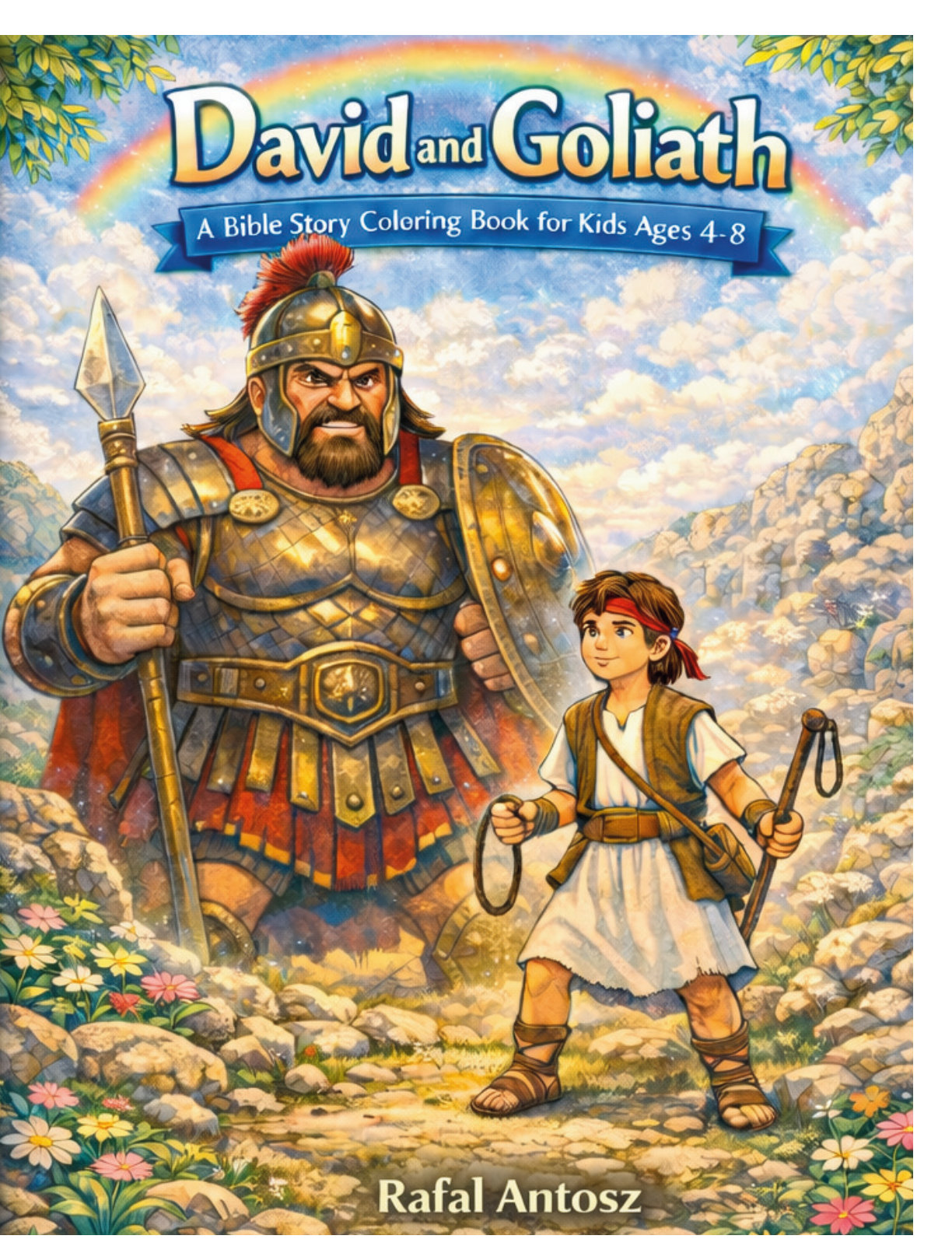
If your child enjoyed this story, the David and Goliath Coloring Book walks through the whole story scene by scene, with a free sample you can try right now.
Continue your family Bible time with more free stories and activities from Little Faith Hands.
Continue with the David and Goliath Coloring Book →